THE MICROMANIPULATOR CO 2550 Manual Probe Positioner Co.
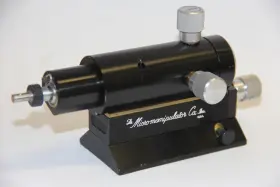
( Brand: The Micromanipulator Co ), ( Part Type: Manual Probe ), ( Manufacturer Part Number: 2550 ), ( Cosmetics: C4 Used Good )
Review THE MICROMANIPULATOR CO Co. Manual Probe Positioner
The Micromanipulator 2550 Manual Probe Positioner is a precision instrument designed for precise and controlled positioning of probes in various applications such as microscopy, semiconductor manufacturing, and scientific research. This manual probe positioner boasts an impressive travel range of 100mm in the X and Y axes and 200mm in the Z axis, enabling it to accommodate a wide range of probe sizes and reach intricate locations.
The Micromanipulator 2550 is constructed from high-quality, durable materials, including a robust stainless steel frame, ensuring stability and longevity. Its compact design makes it an ideal choice for confined workspaces, and its smooth, friction-reducing linear bearings provide precise and consistent movement, with a repeatability of less than 1 micron.
The probe positioner features a user-friendly, ergonomic design, with easy-to-use knobs for controlling X, Y, and Z axis movements. The knobs provide both coarse and fine adjustments, allowing for precise positioning. The positioner also comes with a built-in micrometer scale for accurate measurements and calibration.
The Micromanipulator 2550 Manual Probe Positioner is compatible with a wide range of probes, including capillary tubes, sharp tipped probes, and blunt ended probes. It is also equipped with a probe clamping mechanism that securely holds the probe in place during positioning, ensuring accuracy and stability.
The probe positioner is easy to install, requiring minimal setup time, and can be integrated with various microscopes, automation systems, and other laboratory equipment. It also comes with a comprehensive user manual, providing detailed instructions on operation, calibration, and maintenance.
In summary, the Micromanipulator 2550 Manual Probe Positioner is a versatile, high-precision instrument ideal for applications requiring controlled probe positioning. Its robust construction, extensive travel range, and user-friendly design make it a valuable addition to any laboratory or microscopy setup.
A micromanipulator with a manual probe positioner, such as the model 2550, is a specialized piece of equipment used in various scientific applications, particularly in microscopy and micro-manipulation tasks. Here are some potential pros and cons of purchasing this type of equipment:
Pros:1. Precision and Control: The micromanipulator provides precise control over the movement of a probe or tool, allowing researchers to make precise measurements or manipulations at the microscopic level. The manual probe positioner offers additional control by allowing the user to make fine adjustments to the probe position without the need for motorized controls.
2. Versatility: A micromanipulator with a manual probe positioner can be used in a wide range of applications, including cell biology, biochemistry, material science, and microelectronics. It can be used to manipulate cells, perform micro-surgeries, measure material properties, and assemble micro-devices.
3. Cost-effective: Compared to motorized probe positioners, manual probe positioners are generally less expensive. Manual control also eliminates the need for additional equipment, such as motors and controllers, which can save on costs.
Cons:1. Time-consuming: Manual control of the probe positioner requires more time and effort compared to motorized controls. Researchers may need to spend more time making fine adjustments to the probe position, which can be a limitation in high-throughput or automated applications.
2. Limited Speed: Manual probe positioners are generally slower than motorized controls, which can be a limitation in applications where fast positioning is required. For example, in time-lapse microscopy, where rapid positioning is necessary to capture changes in cell behavior over time, a manual probe positioner may not be suitable.
3. User Dependent: The performance of a manual probe positioner is highly dependent on the skill and experience of the user. Inexperienced users may struggle to achieve the precision and control required for certain applications.
In conclusion, a micromanipulator with a manual probe positioner, such as the model 2550, offers a high degree of precision and control in a cost-effective and versatile package. However, it is a time-consuming and user-dependent tool that may not be suitable for high-throughput or automated applications requiring fast positioning. Researchers should carefully consider their application requirements and skill levels before deciding to purchase this type of equipment.
Based on the above analysis, I would recommend considering a micromanipulator with a manual probe positioner for applications that require precise control over probe positioning, such as cell biology or material science research, where the time and cost savings of manual control outweigh the limitations of slower positioning and user dependency. However, for applications requiring fast positioning or automated control, such as high-throughput microscopy, a motorized probe positioner may be a better option.
Details:
Batteries, or 5. 2550 Manual Probe Positioner: 138528. Collectible/Specialty Electronics. Poly-chlorinated phenol's CBS 2.
CRT glass, except for glass with lead content less than 5 parts per million, and clean of phosphor, fines, coatings Frito 4. No other parts or accessories are included.
part #: 2550 prices
- $179.99-$235.49
specifications curativescope:
- brand: The Micromanipulator Co
- part type: Manual Probe
- manufacturer part number: 2550
- cosmetics: C4 Used Good
offer curativescope:
- availability: In Stock
- sold: 0
- started: April 9, 2025
- quantity: 1
- options: Ship-to-home
- best offers: True
payments curativescope:
- wallet: Paypal
- credit card: Visa
- other
general curativescope:
- Healthcare, Lab Dental > Medical Lab Equipment, Devices > Microscopes
- condition: Used
returns curativescope:
- paid by: Seller
- policy: Returns Accepted
- time: 30 Days
- method: Money back
shipping curativescope:
- carrier: USPS, FedEx
- cost: $15.20
- transit: 3-9 Days
- service: USPS Ground Advantage, FedEx Ground or FedEx Home Delivery, FedEx Standard Overnight
- type: Calculated
- class: Standard, One-day
seller curativescope:
- city: Gilroy, California
- # reviews: 3549
- rating: 98.6%
The Micromanipulator Co 2550 Is Similar To:
- Signatone S-930 Micromanipulator Probe Positioner Jcc17 (62.5% similar) Comes as shown. Has some Cosmetic wear. No means to test. Acquired from a reliable source. Used items have a 30-DAY return...(May 19th, 2025)

2 offers $179.99–$235.49 USD
- Used. Offer #1 priced at $179.99 + $8.80 delivery = $188.79* total. A subset of the primary functions of the device that an ordinary user of the device expects to function are verified working through manual or software tests. This ITEM isUSED.+$8.80 shipping
- Used. Offer #2 priced at $235.49 + $0.00 delivery = $235.49* total. Base: Vacuum Base (1) Micromanipulator positioner / manipulator.FREE SHIPPING