OLYMPUS BX60F-3 Compound Fluorescent Microscope Objectives Eyepieces
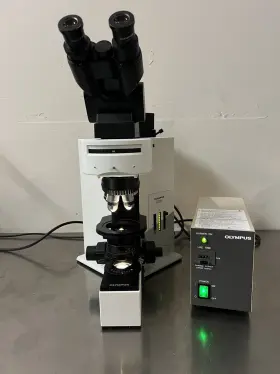
( Brand: Olympus ), ( Part Type: Compound ), ( Microscope Structure: Upright ), ( Microscope Type: Reflected Light ), ( Viewer: Binocular ), ( Manufacturer Part Number: BX60F-3 ), ( Intended Use/discipline: Chemistry, Battery Research, Dark Field, Metallurgical, Semiconductor, Nanotechnology )
Review OLYMPUS Compound Fluorescent Microscope Objectives And Eyepieces
The Olympus BX60F-3 compound fluorescence microscope is a sophisticated instrument designed for advanced research and analysis in various fields, including life sciences, material science, and biotechnology. One of its essential components are the objectives and eyepieces, which are responsible for magnifying the specimen and producing a clear, sharp image. Let's take a closer look at the specifications and features of the Olympus BX60F-3 microscope objectives and eyepieces:
Objectives:The Olympus BX60F-3 microscope comes with a set of high-quality objectives. These objectives offer a wide range of magnification options to suit different research needs. The objectives feature a Plan Apochromat design, ensuring excellent chromatic aberration correction and exceptional image resolution. Some specifications of these objectives are:
1. Four objective lenses are available: 4x, 10x, 20x, and 40x.
2. Lens elements are made of high-refractive index glass for increased light transmission and excellent image quality.
3. Provincial anti-reflection coatings are applied to all surfaces for minimized reflection and enhanced contrast.
4. The objectives have a working distance of 11.1mm to 12.9mm (at 20x objective), making lens changing convenient and user-friendly.
5. The objective lens bodies are made of stainless steel, ensuring durability and resistance to corrosion.
Eyepieces:The Olympus BX60F-3 microscope also includes several high-performance eyepieces. These eyepieces offer excellent brightness, clarity, and field of view for optimal observation experience. Some features of these eyepieces are:
1. Widefield (WF) and UWB (Ultra Widefield Binocular) eyepieces are available, allowing for a larger field of view for better sampling of the observed specimen.
2. Eyepieces provide high resolution and contrast, ensuring the finest details are visible in the specimen.
3. The UWB eyepiece has a magnification of 6.1x, rendering an expansive field of view, which is beneficial for studying large samples or survey scanning of a sample.
4. All eyepieces are designed with a long eye relief of approximately 18mm, accommodating glasses-wearing researchers comfortably.
5. Additionally, the eyepieces feature a rugged design with non-slip eyeguards and adjustable diopters for focusing individual variability.
A Comparative Analysis of the Olympus BX60F-3 Compound Fluorescent Microscope Objectives and Eyepieces
I. IntroductionThe Olympus BX60F-3 is a widely used compound fluorescent microscope in various research applications. This microscope comes with different objectives and eyepieces that can significantly impact the image quality, resolution, and functionality. This analysis aims to provide a comparative overview of the different Olympus BX60F-3 objectives and eyepieces, along with their respective advantages and disadvantages.
II. ObjectivesA. Plan Apochromatic (APO) Objectives
1. Superior image quality due to corrected chromatic aberrations
2. High resolution and contrast, suitable for delicate structures
3. Wide variety of magnifications (4x, 10x, 20x, 40x, 60x, 100x)
4. Ideal for fluorescence and brightfield microscopy
B. Drawbacks
1. Expensive compared to other objectives
2. Heavier and bulkier
3. Requires precise focusing mechanisms
B. Achromatic Objectives
1. Affordable price point
2. Suitable for general observation and teaching purposes
3. Sufficient image quality for routine observations
4. Lighter and more compact
C. Comparison
1. APO objectives provide better image quality and resolution but are more expensive.
2. Achromatic objectives are more affordable but offer less image quality and resolution.
III. EyepiecesA. WF10x
1. Wide field of view (4.3mm)
2. Reduces eye strain with long working distance (18mm)
3. Ideal for observing larger samples
B. UPlanFI10x
1. Superior image quality and resolution
2. Enhanced color contrast
3. Suitable for fine details and complex structures
C. Comparison
1. WF10x offers a wider field of view but with lesser image quality compared to UPlanFI10x.
2. UPlanFI10x has better image quality and resolution but covers a narrower field of view.
IV. ConclusionThe choice between the Olympus BX60F-3 objectives and eyepieces depends on the specific requirements of your research or teaching needs. If higher image quality, resolution, and contrast are paramount, investing in Plan Apochromatic objectives and UPlanFI eyepieces might be the preferred choice. However, if budget constraints exist, Achromatic objectives and WF10x eyepieces offer a more affordable alternative.
V. RecommendationFor advanced research applications, it is highly recommended to invest in Plan Apochromatic objectives and UPlanFI eyepieces to ensure the best possible image quality, resolution, and contrast. For general observation and teaching purposes, Achromatic objectives and WF10x eyepieces remain a suitable option at an affordable price point.
Details:
Everything on the scope works 100% as it should. When I purchased the scope it did not come with objectives so added that used for testing. The shipping quote is for the lower 48 states only. This Olympus microscope has been fully tested and all optics are scratch free clear.
I sell a variety of lab instruments and don't pretend to be an expert at any them so you can never ask many questions please feel free do. Comes with 4 objectives pictured, one filter cube pictured and everything shown in the pictures. This is what I do for a living so every customer or potential very much appreciated.
part #: bx60f3 prices
- $2500.00-$6945.00
specifications curativescope:
- brand: Olympus
- part type: Compound
- microscope structure: Upright
- microscope type: Reflected Light
- viewer: Binocular
- manufacturer part number: BX60F-3
- intended use/discipline: Chemistry, Battery Research, Dark Field, Metallurgical, Semiconductor, Nanotechnology
general curativescope:
- condition: Used
- Healthcare, Lab Dental > Medical Lab Equipment, Devices > Microscopes
payments curativescope:
- credit card: Visa
- other
- wallet: Paypal
offer curativescope:
- started: February 1, 2025
- options: Ship-to-home
- availability: In Stock
- quantity: 1
- sold: 0
seller curativescope:
- rating: 100.0%
- city: Hayward, California
- # reviews: 94
returns curativescope:
- policy: No Returns
shipping curativescope:
- cost: $425.00
- class: Freight
- service: Flat Rate Freight
- type: Fixed
Olympus BX60F-3 Is Similar To:
- Olympus Ix51 Microscope Flourescence (44.2% similar) Selling an untested unit, I do not know how to check this unit so am selling as is. What you see in the pictures is what get...(June 4th, 2024)
- Olympus Cx22 Led Binocular Microscope (40.4% similar) Shipping cost is calculated by zip code and available at the top of page. Oem: Olympus. $350 for packing and pelleting each custom reinforced pallet. Reline will attempt to replace product prior issuing credit. Current rates are $175 for packing and pelleting each standard pallet...(June 6th, 2024)
- Olympus Szh10 Research Stereo Microscope (42.7% similar) Olympus SH-BI45N binocular observation tube. Olympus SH-RE2 double revolving nose piece. Includes: Olympus sh-ilk transmitted light stand with tall upright post. Olympus GWH10X-D eyepieces. Olympus SH-ZB10 zoom microscope body. Olympus sh-pt photo tube with attachment for second...(June 6th, 2024)
- Olympus Ix70-s8f2 Ix70 Fluorescence Phase Contrast Inverted Microscope (47.6% similar) Olympus ix-Afr stage. Olympus ix-RAF/s fluorescence Illuminati. Olympus IX70-S8F2 inverted microscope stand in good optical and mechanical condition with: U-BI90CT binocular tube condition, adjusts properly including the Bertrand lens. The microscope is clean, serviced and in good working...(June 6th, 2024)
- Olympus 201084 Stereozoom Microscope X With Two Sets Of Eyepieces 7.5 Inch 140mm Wd 30-360x (50.9% similar) Rare Olympus stereo zoom microscope model x long working distance 7.5 /140MM focus able mount with two pivot points clamps comes sets of eyepieces G10X G20X zoom magnifications x 10 or 20 3/4 .5 7/1 1 18...(June 11th, 2024)
- Olympus 1001515 Telescoping Microscope Stand Adjustable 1 Inch Dia 12-20.5 Height (40.5% similar) Olympus 1001515 telescoping microscope stand adjustable 1 inch DOA 12-20.5 tall...(June 11th, 2024)
- Olympus Ovd-2 Industrial Digital Microscope Toshiba Dvm-1 Dsm-2 (42.9% similar) There is a palatalization fee of $50 minimum up to 5%OF the purchase price, unless waived by us. The item comes as shown in the picture. 30-DAY money-back guarantee. This is a used item in good working condition. Model digital microscope. Olympus industrial digital microscope, Toshiba DEM-1...(June 11th, 2024)
- Olympus Ab-0655 Ab 0655 Telescoping Microscope Stand 1 Inch Diameter Adjustable 10.5-16 (42.7% similar) Olympus ab 0655 telescoping microscope stand 1 inch DOA adjustable 10.5-16. Threaded upper mount. Base is light and easy to move...(June 11th, 2024)
- Olympus Bx51trf Power Tested Bx51 Fluorescence Microscope With U-lh100-3 (56.4% similar) Score for this product: c used, good. No further testing could be completed due to lack of resources. Condition: for reuse or repair/refurbishment. Collectible and specialty electronics exemption. See pictures for best detail. Included in the sale is: 1 power tested Olympus BX51...(June 11th, 2024)
- Olympus Ix70-s8f Inverted Fluorescence Microscope Infinity 2 Camera Objectives (64.5% similar) Olympus IX70-S8F inverted fluorescence microscope includes 1 Chou technical corp...(June 12th, 2024)
- Olympus Bx40cy Binocular Microscope (42.9% similar) 1755 enterprise parkway suite 4 twins burg, oh 44087, the and photos represent best efforts to convey information our opinions about a product. $350 for packing and pelleting each custom reinforced pallet. Current rates are $175 for packing and pelleting each standard pallet...(June 12th, 2024)

4 offers $2500.00–$6945.00 USD
- Used. Offer #1 priced at $2500.00 + $199.75 delivery = $2699.75* total. Comes with camera on top Laboratory microscope with 300x zoom.+$199.75 shipping
- For parts or not working. Offer #2 priced at $2685.00 + $Calculated delivery = $2685.00* total. Includes 5 objectives.+$Calculated shipping
- Used. Offer #3 priced at $6945.00 + $350.00 delivery = $7295.00* total. Olympus 6x place nosepiece. Olympus BX60 microscope equipped with fluorescence.+$350.00 shipping
- Used. Offer #4 priced at $5900.00 + $250.00 delivery = $6150.00* total. The fluorescence lamp is also working but it is unclear how many hours are on that particular lamp. The Olympus Fluorescent Microscope is an upright unit with binocular viewer and UPlan objectives.+$250.00 shipping