KEYENCE BZ-X710 Automated Fluorescent Microscope Software
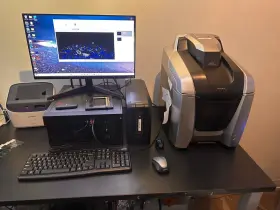
( Brand: Keyence ), ( Microscope Type: Fluorescence Microscope ), ( Viewer: Monitor/display ), ( Manufacturer Part Number: BZ-X710 )
Review KEYENCE Automated Fluorescent Microscope Including Software
The Keyence BZ-X710 automated fluorescence microscope is a state-of-the-art instrument designed for advanced cell biology research, material science, and quality control applications. This all-in-one system integrates an automated inverted microscope, an LED light source for fluorescence illumination, and advanced imaging software for high-performance analysis of labeled samples.
One of the standout features of the BZ-X710 is its automated capabilities, including automatic focus and filter optimization, which enable users to acquire and analyze large datasets with ease. The system is equipped with a high-precision Z-drive system that allows automatic focusing from the top to the bottom of the sample, ensuring that each image is in sharp focus. Additionally, the automated filter optimization feature ensures optimal fluorescence signal intensity, resulting in high-quality images for further analysis.
The BZ-X710 microscope system features a powerful software suite, BZ-II Analyzer, for image acquisition, analysis, and reporting. The software supports multiple fluorescence excitation and emission wavelengths, making it suitable for a wide range of labeled samples. It also offers advanced image analysis tools such as particle analysis, measurement tools, and colocalization analysis, enabling researchers to extract meaningful data from their images.
The system's versatility is further enhanced by its ability to support both live cell imaging and fixed sample analysis. The temperature-controlled stage maintains optimal temperature for live cell imaging, while the automated sample changer allows for the easy analysis of multiple samples without been interrupted.
The BZ-X710 automated fluorescence microscope also offers exceptional image quality, thanks to its high-resolution CCD camera, which delivers images with high pixel density and a wide dynamic range. The system also supports multiple magnifications, from 0.5x to 60x, allowing users to acquire images at various levels of magnification for comprehensive analysis.
The BZ-X710 automated fluorescence microscope is designed for ease of use and flexibility. It can be easily integrated with other lab equipment, such as liquid handling systems, for automated workflows, and its robust design ensures long-term durability. Additionally, the system comes with a user-friendly interface, making it accessible to researchers from various fields, from novice to expert.
In summary, the Keyence BZ-X710 automated fluorescence microscope is a powerful and versatile instrument for advanced imaging and analysis applications. Its automated capabilities, advanced imaging software, exceptional image quality, and support for multiple sample types make it an indispensable tool for laboratories in fields such as cell biology, material science, and quality control.
Pros and Cons of Buying Keyence BZ-X710 Automated Fluorescence Microscope System and Software
Introduction:The Keyence BZ-X700 series microscopes are renowned for their advanced automation and imaging capabilities, making them a popular choice for various research and industrial applications. Among these, the BZ-X710 automated fluorescent microscope system and its associated software are highly sought after. In this analysis, we will examine the advantages and disadvantages of investing in this setup.
Pros:1. Advanced Automation: The BZ-X710 microscope system boasts an impressive level of automation, including autofocus, image acquisition, and analysis. This reduces the need for extensive manual input and can save significant time and effort.
2. Improved Image Quality: Achieving high-quality fluorescent images can be a challenge, but the BZ-X710 delivers crisp, clear images by employing advanced filtering and imaging techniques, including Widefield, Time-lapse, Z-Stacking, and CLSM (Confocal Laser Scanning Microscopy).
3. Compatibility with Various Dyes and Stains: The system is compatible with various fluorophores and imaging probes, enabling users to visualize different structures and biomolecules in their samples, which can lead to a deeper understanding of biological processes.
4. Integrated Analysis Tools: The BZ-II Analyzer software offers preinstalled analysis tools and allows for the creation and customization of analysis macros. These features can help users efficiently extract quantitative data from their images and facilitate research and discovery.
Cons:1. High Cost: The BZ-X710 microscope system and software can be expensive, making it a considerable investment for many researchers and laboratories. The cost may extend to not only the equipment but also accessory costs, such as filter sets and objective lenses.
2. Steep Learning Curve: Operating the full range of this system s capabilities requires extensive training and familiarization. Adequate time and resources must be allocated for systematic learning and implementation to effectively utilize the software.
3. Software Limitations for Large-Scale Projects: While the BZ-II Analyzer software offers powerful analysis tools, it may not be suitable for complex or large-scale projects. In such cases, more specialized software may be required to conduct more in-depth analysis.
Conclusion:The Keyence BZ-X710 automated fluorescent microscope system with the BZ-II Analyzer software boasts numerous advantages, including advanced automation, improved image quality, compatibility with a wide range of fluorophores and stains, and integrated analysis tools. On the other hand, its high cost, steep learning curve, and limitations for large-scale projects are significant disadvantages. In conclusion, this setup is a valuable investment for small to mid-sized research projects and applications that require crisp fluorescent images with minimal input, while larger-scale projects might necessitate further evaluation and additional software.
Advice: To ensure that this investment aligns with your specific research or industrial needs, it is recommended to:1. Evaluate your experimental goals and ensure the BZ-X710 meets those objectives.
2. Assess your available budget and training resources.
3. Explore alternative microscopy systems or companion software that can better accommodate your research or application requirements.
Details:
Key Features: Imaging Modes: Supports fluorescence, bright field, and phase contrast imaging, accommodating a wide range of specimen types. Its all-in-one configuration simplifies the imaging process, making it a valuable asset for laboratories requiring efficient and reliable microscopy solutions. Recent Maintenance: The microscope is approximately 10 years old and has recently undergone a major repair with the replacement of stage, ensuring continued reliability. This unit includes color cubes and 10x, 20x, 40x objective lenses, providing a comprehensive solution for fluorescence, bright field, phase contrast microscopy.
Objective Lenses: Equipped with Nikon CFI 60 Series infinite optical system objectives at 10x, 20x, and 40x magnifications, offering flexibility for different imaging requirements. Advanced Functions: Includes capabilities for image stitching, Z-stack imaging, and optical sectioning, enhancing imaging versatility. This microscope is in good working condition, with all components functioning properly. The recent stage replacement addresses a critical maintenance aspect, enhancing its operational reliability.
Built-in Darkroom: Features an integrated specimen enclosure, enabling fluorescence imaging in well-lit environments without the need for external darkroom. The BZ-X710 is renowned for its user-friendly design and high-quality imaging capabilities.
part #: bzx710 price
- $18300.00
specifications curativescope:
- brand: Keyence
- microscope type: Fluorescence Microscope
- viewer: Monitor/display
- manufacturer part number: BZ-X710
seller curativescope:
- rating: 0.0%
- city: Menlo Park, California
- # reviews: 0
general curativescope:
- Healthcare, Lab Dental > Medical Lab Equipment, Devices > Microscopes
- condition: Used
offer curativescope:
- availability: In Stock
- sold: 0
- started: December 19, 2024
- options: Ship-to-home
- quantity: 1
shipping curativescope:
returns curativescope:
- policy: No Returns
payments curativescope:
- wallet: Apple-pay
- other
- credit card: Visa
Keyence BZ-X710 Is Similar To:
- Keyence 1441012 Vk-x250 Vk-200k Laser Microscope 3d And Profile Measurement S7581 (43.4% similar) Please look at the pictures. Has some scuffs on the sides. Keyence VJ-X250 VJ-200K laser microscope 3d profile measurement. Power cord is included. Unit is only tested for power, powers up and the lights come on fan comes...(June 18th, 2024)
- Keyence Vhx-s90be Digital Microscope System Free-angle Observation (41.5% similar) Keyence HX-S90BE. This product has been fully inspected to avoid any buyer surprises...(August 20th, 2024)
- Keyence Vh-8000 Vh-8c00 Electron Microscope Host (47.9% similar) User-friendly interface: intuitive controls and software make operation seamless for both beginners experts. Versatile applications: perfect for research, quality control, and educational purposes across various fields. Unlock the power of advanced imaging with Keyence VHF-8000 electron...(October 15th, 2024)
- Keyence Vhx-600 vh-z100r vh-s5 Digital Microscope M5782 (41.9% similar) The unit was tested and is in great working condition. It just needs a little cleaning on the display small dots of dirt. Item includes a 30 day warranty. Keyence HX-600/VHF-Z100R/VHF-S5 digital microscope M5782 warranty information: this is a used item and has been checked...(December 2nd, 2024)
- Keyence Vh-s30k Vhx Digital Microscope (41.1% similar) The sheathing of the primary cord was damaged and has been wrapped in black electrical tape. It is visible in the photos. The underlying optical cords were undamaged, item remains functional. A few scratches, nothing serious...(December 8th, 2024)
- Keyence Vhx-7100 Digital Microscope Head Unit With Vhx-s750e Motorized Stand Bas (45.6% similar) Paired with the HX-S750E motorized stand base, this microscope offers unmatched precision and ease of use. Applications: perfect for applications in material science, electronics, quality control, and research environments. The Keyence HX-7100 digital microscope is a cutting-edge imaging...(December 19th, 2024)
- Keyence Bz-x810 Fluorescence Microscope (66.7% similar) Automated features: fully motorized stage for precise control and high-throughput sample imaging. Advanced fluorescence imaging: supports multi-color fluorescence imaging with minimal cross-talk between channels. Drug discovery: high-throughput imaging for screening drug effects on cells...(January 28th, 2025)
- Keyence Vhx-7000 2020 Digital Microscope With Vhx-s770e Xyz Motorized Tilting Stand (46.1% similar) 2020 Keyence HX-7000 digital microscope W/HX-S770E XS motorized tilting stand, includes: controller unit w/high resolution display HX-S770E large free-angle observation system XS motorized stage, z focus HX-7020 high performance camera VHF-Z20UR RZX20 - X200 universal zoom lens w/...(February 22nd, 2025)
- Keyence Vhx-500 Vhx-500k Digital Portable 3d Light Microscope With Vh-s30k (42.8% similar) This doesn't affect functionality and is strictly cosmetic. 615 Capistrano Dr. Please with any questions. Ready for your lab or bench. Depending on the size of item there may be a pelleting/crating fee. Please for pricing. This will aide in providing a more accurate...(May 30th, 2025)
- Keyence Vw-9000e High-speed Microscope Cpu Only (46.6% similar) Its unique all-in-one design includes a built-in light source, hard disk drive, LCD monitor and PC components, making it extremely easy to set up operate. The VW-9000 integrates with a high-speed camera not included digital microscope system, giving users the ability to perform both macro and...(June 14th, 2025)
- Keyence Vw-z2 Macro Zoom System Microscope Lens M6660 (44.3% similar) Glad you stopped by. Keyence VW-Z2 macro zoom system microscope lens M6660 brand:: Keyence, condition: this is a used item, in good condition and includes 30 day warranty. Extra information:: excellent condition. We proudly sell hard-to-find parts, components, and machines to makers...(July 14th, 2025)

1 offer $18300.00 USD
- Used. Offer #1 priced at $18300.00 + $400.00 delivery = $18700.00* total. PC: DELL Precision Tower3420, OS: Windows10. KEYENCE / All-in-one Fluorescence Microscope.+$400.00 shipping