RAY VISION NJC-1 Manual Lensmeter Focimeter Lensometer Optic Optometry
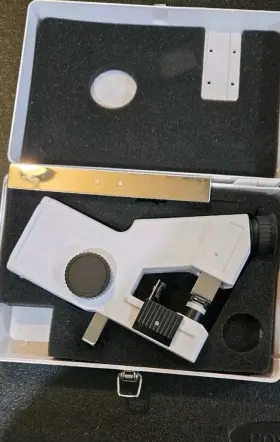
( Brand: Ray Vision ), ( Part Type: Manual ), ( Unit Type: Unit ), ( Country/region Of Manufacture: China ), ( Lensmeter Type: Manual Lensmeter ), ( Manufacturer Part Number: NJC-1 )
Review RAY VISION Portable Manual Lensmeter Focimeter Lensometer Optometry Optic Machine
The Ray Vision NJC-1 Manual Lensmeter/Focimeter is an essential tool for optometry and optic professions that allows for precise and accurate measurement of optical lenses. This versatile instrument is designed to determine the power, sphere, cylinder, axis, and prism of various types of lenses.
The NJC-1 Manual Lensmeter features a high-quality optical system that utilizes a 1.5x magnification for clear and detailed lens readings. The instrument comes with interchangeable rings to accommodate different lens diameters, ranging from 14mm to 78mm. Additionally, it includes a prism adjustment feature that can measure prism values up to /- 5.0 base-in or base-out.
The lensmeter has an easy-to-read, illuminated digital display that shows the measurement results. It also includes a built-in target that helps in focusing the instrument and ensuring accurate readings. The instrument is battery-operated and comes with a protective case and a neck lanyard for easy carrying and storage.
The NJC-1 Manual Lensmeter is a durable and reliable instrument, made from high-quality materials that ensure long-lasting performance. It is easy to use, with clear instructions provided in the user manual. The instrument is also calibrated for accuracy and comes with a one-year manufacturer's warranty.
Overall, the Ray Vision NJC-1 Manual Lensmeter/Focimeter is an indispensable tool for optometrists, opticians, and other optic professionals who require precise and accurate measurements of optical lenses. Its high-quality optical system, interchangeable rings, prism adjustment feature, and easy-to-read digital display make it a valuable addition to any optic lab or practice.
Pros and Cons of buying a Ray Vision NJC-1 Manual Lensmeter/Focimeter
1. Pros of buying a Ray Vision NJC-1 Manual Lensmeter/Focimeter:a. Cost-Effective: The Ray Vision NJC-1 is an affordable option for optometrists, opticians, and students looking for a manual lensmeter/focimeter. Its reasonable price makes it an accessible tool for those who may not be able to invest in more expensive automated models.
b. Portable: The compact and lightweight design of the NJC-1 makes it easy to carry around in a lab or clinic. It can be taken to different examination rooms or used during patient consultations, making it a versatile choice for various optometric settings.
c. Durable: The lensmeter's sturdy construction ensures its longevity. It is made of high-quality materials, which can withstand frequent use and rough handling. This makes it a reliable investment for professionals who require a dependable instrument for their practice.
d. Manual Operation: The manual operation of the lensmeter offers greater control over the measurement process. It enables users to fine-tune their adjustments and achieve more accurate results, especially when dealing with complex prescriptions or difficult-to-measure lenses.
e. Interchangeable Lens Cylinder: The NJC-1 comes with an interchangeable lens cylinder, which allows users to measure different spherical and cylindrical powers. This versatility makes it a valuable addition to any optometric practice or educational setting.
2. Cons of buying a Ray Vision NJC-1 Manual Lensmeter/Focimeter:a. Manual Operation: While the manual operation offers greater control, it also requires more time and effort to perform measurements. This may not be suitable for high-volume practices, as it could slow down the examination process.
b. Limited Automation: The NJC-1 does not offer the advanced automation features found in more expensive lensmeters. This means that users will need to perform all measurements manually, which could potentially introduce human error.
c. Learning Curve: Manual lensmeters like the NJC-1 may have a steeper learning curve compared to automated models. Users may need to spend more time practicing and becoming familiar with the instrument to achieve optimal results.
d. Limited Measuring Range: The NJC-1 has a limited measuring range, which may not be suitable for all prescriptions. For example, it may not be able to measure extremely high or low prescriptions. This could limit its usefulness in certain optometric practices.
e. Lack of Advanced Features: The NJC-1 does not offer advanced features such as digital displays, automatic dark adaptation, or integration with electronic health records. These features may be important for some users, especially those in larger practices or research settings.
Conclusion:The Ray Vision NJC-1 Manual Lensmeter/Focimeter is an affordable, portable, and durable option for optometrists, opticians, and students. Its manual operation offers greater control over measurements, and its interchangeable lens cylinder makes it a versatile tool. However, it requires more time and effort to use, has a limited measuring range, and lacks advanced features found in more expensive models.
Recommendation:The Ray Vision NJC-1 Manual Lensmeter/Focimeter is an excellent choice for optometric practices or educational settings with limited budgets or those that prioritize manual operation and versatility over advanced automation features. It is a reliable and durable instrument that can provide accurate measurements with consistent practice. However, it may not be suitable for high-volume practices or those that require advanced features or a wider measuring range. In such cases, more expensive automated lensmeters may be a better investment.
Details:
Experience precision in lens measurement with the Ray Vision NJC-1 Manual Lensmeter, a must-have tool for optometrists and ophthalmologists. Designed for accuracy and simplicity, this lensometer allows quick easy readings, ensuring that your patients receive the correct prescription every time. Crafted by Ray Vision, a trusted name in optical instruments, the NJC-1 is manufactured China, adhering to high-quality standards. This model is specifically engineered to cater your clinical needs, providing reliable results that are essential for effective eye care.
specifications curativescope:
- brand: Ray Vision
- part type: Manual
- unit type: Unit
- country/region of manufacture: China
- lensmeter type: Manual Lensmeter
- manufacturer part number: NJC-1
offer curativescope:
- sold: 0
- quantity: 1
- started: February 16, 2025
- options: Ship-to-home
- availability: In Stock
- best offers: True
returns curativescope:
- policy: No Returns
payments curativescope:
- wallet: Google-pay
- other
- credit card: Visa
general curativescope:
- condition: Used
- Healthcare, Lab Dental > Medical Lab Equipment, Devices > Microscopes
seller curativescope:
- rating: 0.0%
- # reviews: 0
- city: Anchorage, Alaska
shipping curativescope:
- class: Expedited
- carrier: USPS
- service: USPS Priority Mail
- type: Calculated
- transit: 6-12 Days
- cost: $23.49
